
AirAsia Declares 'Final Chapter' of Restructuring with Bold Plan to Become First Global Narrowbody Carrier
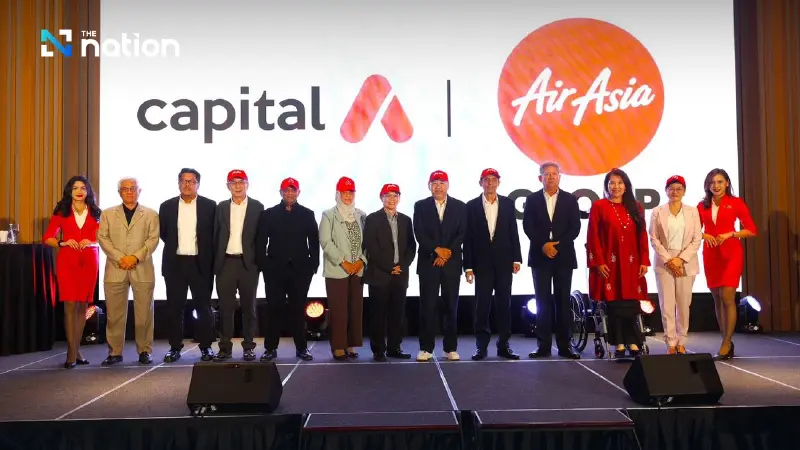


Capital A finalises airline disposal to create two separate entities, targeting 600-aircraft fleet and NASDAQ listing for digital arm
- Capital A has finalized its restructuring by selling its airline business to AirAsia X, creating two distinct companies: the consolidated AirAsia Group for airline operations and Capital A for its digital and travel subsidiaries.
- The airline aims to become the world's first global narrowbody carrier, planning to establish new hubs in the Middle East and Europe to support flights to destinations like America.
- This global expansion will be powered by a fleet transition exclusively to narrowbody aircraft, such as the Airbus A321XLR, with a target to grow from 255 to 600 planes over the next decade.
- As part of the consolidation, all seven of the company's airlines across Asia will operate under the single AirAsia Group brand, and the AirAsia X brand will be discontinued.
Capital A finalises airline disposal to create two separate entities, targeting 600-aircraft fleet and NASDAQ listing for digital arm.
Tony Fernandes declared "the final chapter" of Capital A Berhad's tumultuous restructuring on Thurday, marking the completion of all conditions required for the disposal of its airline business to AirAsia X Berhad nearly six years after the COVID-19 pandemic began.
In an emotional press conference addressing media, board members and staff, the Capital A chief executive described the journey as "really, really tough," comparing the PN17 status period to the pandemic itself.
The final regulatory consent letter arrived just 20 to 30 minutes before Bursa Malaysia closed yesterday, bringing an 18-month disposal process to its dramatic conclusion.
"I'm actually really worn out... the adrenaline has been going for a long, long time. We have landed, and are about to take off again," Fernandes told attendees, characterising the event not as an ending but as a transition to renewed growth.
Two Distinct Entities Emerge
The restructuring creates two separate, focused companies with ambitious growth trajectories:
AirAsia Group – the new name for AirAsia X – will consolidate all seven airlines across Malaysia, Thailand, Indonesia, the Philippines and Cambodia under a single brand and network. The AirAsia X brand will be discontinued as the group merges short-haul and medium-to-long-haul operations.
Capital A will house five high-growth digital and travel-related subsidiaries that Fernandes proudly referred to as a "COVID baby," born out of necessity when aircraft were grounded.
The company aims to complete administrative filings with the High Court of Malaya by around 12 December, list the renamed AirAsia Group shares by the end of December, and secure PN17 status uplift by 31 December.
Crucially, the aforementioned restructuring of Capital A will not affect the operations of Thai AirAsia or Asia Aviation Public Company Limited (AAV) in any way.
Ambitious Fleet and Network Expansion
Fernandes unveiled a bold vision to transform AirAsia into the world's first narrowbody airline to fly globally, underpinned by a dramatic fleet expansion and new strategic hubs outside Asia.
The airline group has cancelled its order for widebody A330 aircraft and will transition entirely to narrowbody operations using Airbus A321neo and the longer-range A321XLR aircraft, which can fly for up to nine and a half hours.
From its current fleet of 255 aircraft (with 15 still to be reactivated), AirAsia Group targets growth to 600 aircraft over the next decade – approximately 580 of which will be narrowbody jets. The group is "very close to finalising a large aircraft order" for another 150 aircraft.
Passenger volumes are projected to increase from the pre-COVID peak of 90 million – which made AirAsia the fourth-largest airline in Asia – to 155 million. The network will expand from 143 destinations currently to 175 over the next 10 years.
The group is working towards establishing a hub in the Middle East and has "been offered a hub in Europe, where we'll use that to fly on to America," Fernandes revealed.
The airline has already begun its westward expansion with routes to Kazakhstan and Uzbekistan, with Istanbul expected to be the first European destination.
Fernandes emphasised that Kuala Lumpur International Airport is the number one megahub in Asia and fourth globally, with AirAsia as its largest contributor.
"The bulk of our business always is going to be Asia," he confirmed, noting plans to significantly increase investment and expand routes in Indonesia.
Financial Targets and Capital A's Five Pillars
Setting an audacious financial goal, Fernandes declared, "For me, my goal before I retire is to try and get to the Emirates margin of 30% EBITDA margin, and I really think we can do that."
He attributed the feasibility of this target to the creation of Capital A's five subsidiary businesses:
AirAsia NEXT (formerly Abc.) – The technology and artificial intelligence company houses digital assets, the loyalty programme and BigPay. Fernandes confirmed that the NASDAQ IPO process has commenced, making it the first Capital A entity targeted for a US listing. The subsidiary is building its own payment gateway to reduce transaction costs.
AirAsia MOVE – The online travel agency, which Fernandes described as "probably the biggest company we have in Capital A" and "the toughest company I've had to build." He noted it is "the first in the world" where an airline has separated its website into a standalone OTA, maintaining the crucial link with customers and ancillary income.
ADE (Asia Digital Engineering) – The maintenance, repair and overhaul provider can complete a seed check "about two and a half days to three days faster than any other MRO," generating 900 additional flying days for the airline annually at lower cost.
Teleport – The logistics arm has increased aircraft cargo utilisation from 12% to 22-23% and has "just overtaken Singapore Airlines as the number one logistics provider." Fernandes projected that "AirAsia will, through the creation of Teleport, earn at least a billion ringgit in the not-too-distant future from cargo."
Santan – The food and beverage brand commercialises in-flight meals on the ground, benefiting from what Fernandes called "a free marketing platform" seen by 90 million people annually.
The RM1 billion placement deal for AirAsia X is expected to close "within the next 30 days, as soon as we complete the paperwork."
Fernandes noted that financial markets have been "very, very positive on AirAsia and Capital A" since emerging from PN17 status.
Resilience and Sustainability
Fernandes expressed extensive gratitude to stakeholders who supported the company through crisis, particularly credit partners like Aries who "lent us a lot of money" and "had vision" when others would not.
He stressed that AirAsia received "not one support" from the government and "no financial loans from any financial institution" save one, yet managed to repay "a billion US dollars of refunds" and rehire all 2,000 staff who were made redundant.
"Nothing was easy for us. Everything was really, really tough," he said, noting that restarting an airline with 255 grounded planes was harder than starting AirAsia from scratch 23 years ago.
Looking ahead, the company plans to implement sustainability initiatives including carbon tax and carbon offset projects in the new year, with a focus on keeping carbon tax revenues in the region.
Fernandes gave special thanks to CFO Teh Mun Hui, recently recognised by Fortune magazine as the 81st Most Powerful Woman in Asia, for her instrumental role in completing the complex financial and regulatory requirements.
He concluded with characteristic boldness: "I told the Pope the other day that after Jesus Christ, AirAsia is the next person to rise from the dead. Believe the unbelievable... Never let anyone tell you you can't do it."
