
Israel, Europe and Australia Anchor in Koh Phangan, Driving Property Investment Past THB7.9bn
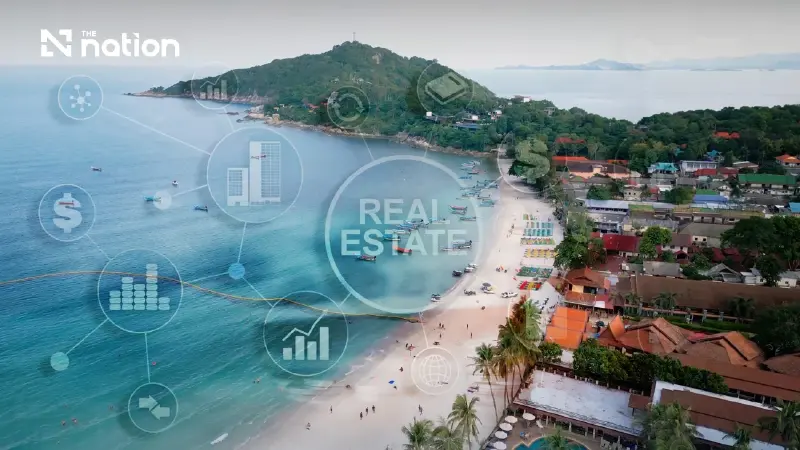


Foreign buyers drive a structural shift on the Thai island, transforming the holiday hotspot into a mature international real estate hub
- Property investment on the Thai island of Koh Phangan has surpassed THB 7.9 billion, driven primarily by international buyers from Israel, Europe, and Australia.
- This influx of foreign capital is transforming the island from a holiday destination into a mature real estate market for long-term residency and second homes.
- The holiday villa and luxury vacation home sector is the main driver of this growth, accounting for over THB 6.8 billion of the total investment.
- Buyers from Israel have established a significant niche, preferring properties for long-term personal use combined with professional rental management.
Foreign buyers drive a structural shift on the Thai island, transforming the holiday hotspot into a mature international real estate hub.
The international real estate landscape in the Gulf of Thailand is undergoing a profound structural shift. Koh Phangan, long celebrated as a world-renowned holiday destination, has successfully transitioned into a mature international property market.
Inflows into residential developments have soared past 7,940 million baht, propelled by robust purchasing power from Israel, Europe and Australia.
According to a comprehensive market analysis by Krungthep Turakij reporter Busskorn Phoosae, the island is rapidly shedding its singular identity as a tourism hotspot. Instead, it is emerging as a premier investment centre and a highly sought-after "second home" destination for expatriates seeking long-term residency.
The holiday villa and luxury vacation home sectors have established themselves as the primary catalysts for this expansion, accounting for more than 6,830 million baht of the total capital deployed.
Sustained Capital Inflows and Market Expansion
Phattarachai Taweewong, director of Research and Communications at Colliers (Thailand) Co., Ltd., stated that the residential sector on Koh Phangan maintained significant growth during the first quarter of 2026.
This upward trajectory underscores the island’s newly cemented status as a real estate market structurally aligned with foreign investment and long-term settlement.
The market currently features 41 active residential projects comprising 438 individual units, representing an aggregate investment value of approximately 7,940 million baht.
The available inventory spans condominiums, luxury vacation homes and exclusive housing estates. Analysts view this diverse product mix as clear evidence that the market is in a healthy "expanding phase", capable of accommodating escalating international demand.
Villa Segment Dominates with THB 6.8bn Influx
The holiday villa sector remains the undisputed cornerstone of the Koh Phangan market. There are currently 26 projects actively selling a combined total of 294 units, commanding a valuation of over 6,830 million baht—the lion's share of the island's total real estate wealth.
Prime institutional and private interest remains heavily clustered along the western and northwestern coastlines, particularly around Mae Haad, Haad Yao and Hin Kong.
These specific enclaves are highly prized for their panoramic sea views, strict privacy and tranquil resort-style environments. Consequently, they attract mid-to-high-net-worth buyers targeting both long-term personal use and lucrative vacation-rental yields.
Conversely, the condominium sector remains boutique, with just four active projects yielding 66 units valued at an estimated 380 million baht. These developments are primarily located in the high-potential areas of Sri Thanu and Haad Yao, which cater to the island’s burgeoning wellness and digital nomad communities.
The housing estate segment comprises 11 projects totalling 78 units, valued at roughly 730 million baht, providing a more accessible entry point for buyers seeking permanent or semi-permanent residences without the premium price tag of a luxury villa.
The Geopolitics of Purchasing Power
Colliers' data reveals that overseas capital remains the lifeblood of the local property economy. Buyers from Israel, Europe and Australia are the key demographics shaping the villa and holiday-home landscape.
Notably, Israeli investors have carved out a highly distinctive and fast-growing niche market over recent years. Their purchasing patterns show a distinct preference for long-term personal residency integrated with professional rental management.
As a result, tranquil locations that offer natural isolation alongside established expatriate communities have become their primary targets.
Accelerating Supply Meets Long-Term Commitments
To keep pace with this structural shift, developers have significantly accelerated new project launches. Between 2024 and 2025, 231 new vacation homes were brought to market. The momentum peaked in 2025 alone, when 131 new units were introduced—a remarkable rate of expansion compared to historical averages.
This aggressive supply response reflects deep developer confidence in Koh Phangan's long-term fundamentals, which are underpinned by an increasing volume of high-spending tourists, steady demand for premium properties and a secular trend of foreign nationals relocating to Thailand.
To navigate statutory restrictions regarding foreign land ownership in Thailand, the vast majority of these developments are structured as 30-year leaseholds. This framework aligns seamlessly with local legal parameters while effectively securing the commercial requirements of mid-to-long-term international investors.
Zoning by Lifestyle: The Three Star Locations
An evaluation of buyer demographics indicates that demand on the island has bifurcated cleanly along distinct lifestyle choices:
Sri Thanu and Hin Kong: This region has solidified its status as the epicentre for European expatriates and digital nomads. Defined by a holistic wellness culture, an established international community, organic cafes and prominent yoga studios, it is overwhelmingly treated as a permanent residential community rather than a seasonal holiday village.
Haad Yao, Haad Salad and Mae Haad: These areas remain exclusive enclaves for affluent buyers prioritising uncompromised privacy, dramatic hillside topography and high-end luxury architecture. The dramatic terrain drastically increases the scarcity and premium value of villa plots here.
Thong Sala and Baan Tai: Serving as the logistical and infrastructure backbone of the island, this zone is highly favoured by yield-focused investors. Its proximity to ferry terminals, retail infrastructure and year-round lifestyle amenities guarantees stable, consistent rental demand.
The contemporary real estate narrative of Koh Phangan is one of profound maturation. The market is no longer hostage to cyclical tourism trends; instead, it is entering a definitive structural growth phase.
Driven by a sophisticated influx of global capital, organised lifestyle zoning and a well-paced pipeline of new supply, Koh Phangan is successfully repositioning itself from a famous party island into one of the most compelling new luxury real estate markets in the Asia-Pacific region.
