
IMF's Georgieva urges calm amid renewed US-China trade tensions
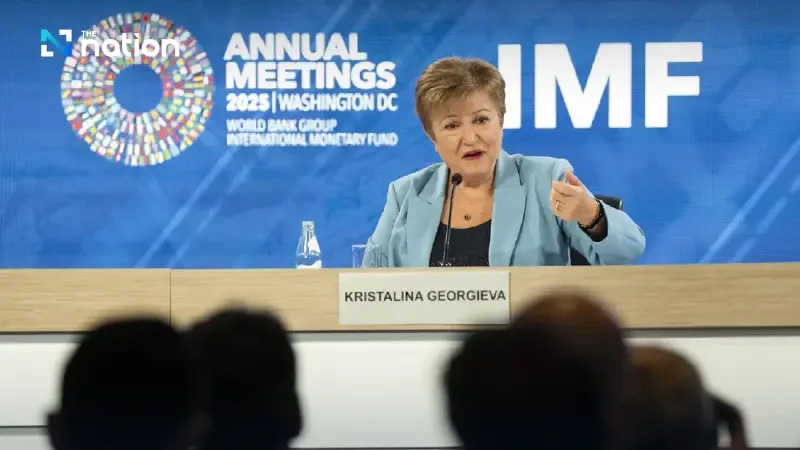


International Monetary Fund (IMF) Managing Director Kristalina Georgieva on Thursday called on member countries to preserve global trade as a driver of growth, warning that fresh tariff escalations could endanger the fragile recovery of the world economy.
Speaking at the IMF–World Bank annual meetings, Georgieva painted a cautious picture of global prospects — stronger than expected earlier this year but still overshadowed by inflationary pressure, high debt and rising social unrest.
The IMF now projects global real GDP growth at 3.2 % for 2025, a touch lower than last year’s 3.3 % but higher than its July forecast of 3 %. Earlier, in April, it had cut projections to 2.8 % after US President Donald Trump imposed sweeping tariffs that sparked tit-for-tat measures from China.
That uneasy calm was shattered when Beijing introduced new export controls on rare-earth metals, prompting Trump to retaliate with 100 % duties on Chinese imports.
Georgieva noted that only the United States, China and Canada have raised tariffs so far, urging other nations to show restraint. “If trade tensions flare up again, the impact on inflation, growth and jobs would be severe,” she cautioned. “Our message is simple: please don’t go down that path, it’s not healthy.”

Out of the IMF’s 191 member states, 188 have refrained from retaliatory trade barriers, instead boosting commerce among themselves. Georgieva singled out India, saying it still maintains certain restrictions but appears open to deeper engagement with partners such as the European Union.
She also stressed that countries with large surpluses, like China, should depend more on domestic consumption, while deficit nations such as the US must narrow fiscal gaps to support balanced growth.
On technology, Georgieva described artificial intelligence as “a double-edged sword”, noting that booming investment, concentrated mostly in the US, could add 0.1 to 0.8 percentage points to global output, but also widen the divide between rich and poor nations.
Public debt, she warned, remains close to record levels, while growing inequality and uncertainty are fuelling protests across many regions. “The forces of change are making the global economy less predictable,” she said. “People are anxious, taking to the streets to demand better opportunities.”
In an interview with Bloomberg Television, Georgieva urged calm amid the renewed US–China trade conflict, saying: “Our message to everyone is, stay cool.” She also cautioned China to “be careful not to provoke others in a way that may make them see China as a threat.”

The escalating dispute has dominated this year’s IMF meetings after Beijing’s new curbs on rare-earth exports and Trump’s vow to expand tariffs. European nations, meanwhile, are exploring ways to coordinate their response.
While acknowledging that the world economy has shown resilience against US tariffs so far, Georgieva warned countries not to become complacent, stressing that if more nations adopt protectionist measures, “we could easily find ourselves in a full-blown trade war and a reshuffling of global supply chains.”
