
Japan local govts, fishers working to save seaweed forests
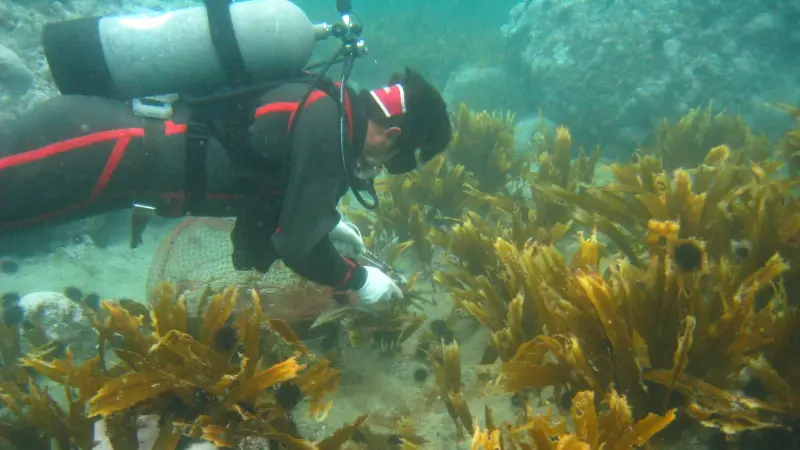


Local governments and fishery operators in Japan on Wednesday (December 17) have sprung into action after lush "moba" seaweed and seagrass beds throughout the country have turned barren due to rising sea temperatures and overgrazing by fish and shellfish.
- Local governments and fishery operators in Japan are collaborating to restore vital seaweed forests, known as "moba," which are disappearing due to rising sea temperatures and overgrazing.
- One key strategy involves controlling sea urchin populations, with one town successfully using crushed urchin shells as a fertilizer to promote new kelp growth.
- To combat other grazing species, one prefecture is paying fishers to catch nuisance parrotfish, which are then processed into minced meat and served in local school lunches.
- In addition to removing grazers, some initiatives involve actively planting new brown algae and eelgrass on the seabed to accelerate the recovery of the marine forests.
Known as "a cradle for fish" in Japan, this ecosystem plays an important role as a place where fish come to lay eggs and grow up.
The town of Shakotan in the northernmost prefecture of Hokkaido launched efforts to revive the rich ocean greenery after such marine forests in its coastal areas were destroyed 15 years ago.
In addition to reducing the population of sea urchins, which were doing the biggest damage to the marine plants, the town also used the sea urchin shells as fertiliser for kelp.

The fertiliser, a mixture of sea urchin shells and natural rubber, "includes ingredients to promote growth of kelp, such as nitrogen and phosphorus, helping create 1.5 hectares of new moba in 15 years," a town official said.
More kelp has led to more sea urchin meat.
Demand for the fatter sea urchins has risen, with sea urchin meat selling for 80,000 yen per kilogram at a local market in summer this year.
Officials of the town of Hayama in Kanagawa Prefecture, south of Tokyo, said that sea desertification became noticeable in the town's coastal areas around 2020.
The town, together with fishery operators and other industry sectors, has formed a council aimed to revive the local moba, working on getting rid of sea urchins, as well as planting brown algae Ecklonia cava and eelgrass on the seabed.
The efforts have resulted in a recovery of about 12 hectares of marine forest.
Besides sea urchins, parrotfish and rabbitfish also cause damage to seagrass and seaweed forests.
The Chiba prefectural government started a project in fiscal 2024 to ask local fishery cooperatives to buy parrotfish and other sea forest nuisances caught by fishery operators.
The purchased parrotfish is turned into minced meat by a seafood-processing business and served at lunches of elementary and junior high schools in the city of Katsuura and the town of Onjuku in the prefecture located east of Tokyo.
The prefectural government is also trying to come up with ideas to utilise rabbitfish, scalpel sawtail and other fish.
"We hope for sustainable efforts (to revive seagrass and seaweed beds), as (moba) not only protects biodiversity by offering more habitat for fish and shellfish, but also contributes as a blue carbon ecosystem by being a carbon sink," a Fisheries Agency official said.

[Copyright The Jiji Press, Ltd.]
