
Police chief warns severe penalties for drone disruptions at Suvarnabhumi Airport
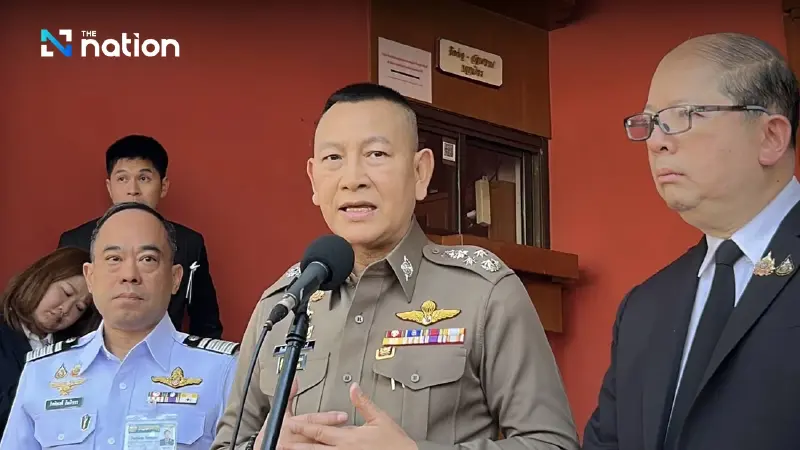


The national police chief has issued a stern warning regarding drone disruptions at Suvarnabhumi, confirming heavy penalties, including the death sentence for violations.
At 11.15am on Monday, December 22, Pol Gen Kitrat Phanphet, the national police chief, addressed the media at Government House following a National Security Council (NSC) meeting. The briefing focused on the recent appearance of unmanned aerial vehicles (drones) near Suvarnabhumi Airport.
Kitrat explained that the Royal Thai Police’s operations related to drones are part of a joint effort with the Royal Thai Air Force’s anti-drone centre, established after a resolution by the NSC earlier this year.
He outlined the operational zones for managing drone activity, which are divided into three areas: the inner zone, referred to as the “red zone,” managed by the Air Force and Airports of Thailand (AOT); the middle zone, or the “white zone,” under the police’s responsibility; and the outer zone, managed by the Army.
The police chief stated that both short-term and long-term security measures, including countermeasures against drone activity, have been carefully planned. He added that these law enforcement operations are based on successful models from the capital and Nakhon Ratchasima.
Kitrat also discussed the integration of various agencies, including the Civil Aviation Authority of Thailand (CAAT), the National Broadcasting and Telecommunications Commission (NBTC), AOT, and the military. These agencies are working together to assess the situation and formulate responses.
On the legal front, he clarified that the use of drones in restricted areas, such as airports, is an offence under the Certain Offences Against Air Navigation Act BE 2558 (2015), with penalties including the death sentence.
If threats to national security are identified, the provisions of the Criminal Code relating to national security would apply, with a maximum penalty of life imprisonment.
“We want to make it clear to those who may be considering disruptive actions that the penalties are severe,” Kitrat warned.
In response to media questions regarding the origins of the drones spotted at Suvarnabhumi, Kitrat stated that the investigation into the exact number of drones is ongoing. While some reports suggested as many as 40 drones, this information remains unverified.
When asked if the presence of 40 drones could be considered an act of terrorism, Kitrat explained that this is still under investigation. While the event could potentially qualify as an act of sabotage, the severity will be evaluated based on the facts.
He emphasised that all agencies involved must prepare for the worst-case scenario and ensure that preventive measures are in place to protect aviation and public safety.
Kitrat also clarified that some objects initially believed to be drones may have actually been aircraft lights, which can be verified through the Flightradar application. He urged the public to report any drone sightings immediately so authorities can act quickly.
Additionally, he confirmed that the police have already implemented emergency response plans to address potential drone threats during the New Year period, especially amid ongoing security concerns related to the Thai-Cambodian border conflict.
“We are fully committed to securing the nation and ensuring that no one can disrupt the peace,” Kitrat concluded.
