
Election to shape response as 2026 may bring Thailand’s new era of extreme weather
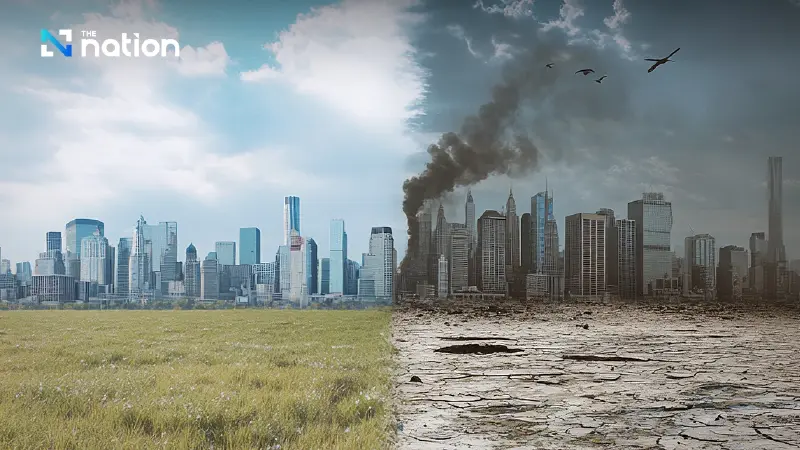


Forecasts suggest 2026 could mark a new phase of extreme weather globally. In Thailand, the next government’s policies may determine how well the country copes with escalating climate risks.
Tara Buakamsri, director of the Climate Connectors programme, says Thailand is entering a period of rapidly shifting climate conditions — and that global heating is no longer just an environmental issue, but the backdrop shaping economic security, public health, energy stability and people’s quality of life.
Thai politics, he argues, can no longer respond with slogans or by brushing aside scientific evidence.
Tara cited the latest outlook from the UK Met Office, which forecasts that average global temperatures in 2026 are likely to be more than 1.4°C above pre-industrial levels (1850–1900).
The central estimate is 1.46°C, with a likely range of 1.34–1.58°C. He warned this includes a risk that the world could “briefly approach or exceed 1.5°C” again.
“This is not some distant future,” he said. “It is the reality the Thai state will have to manage — from the cost of living, the power system and factories, to cities and public health. If policies and infrastructure are still built on old assumptions, many areas are already falling behind systemic change.”
Thailand warming faster than the global average, with layered risks
Tara said the global average is only the “headline”. What Thais experience is local and national temperatures — and these can rise faster than the global mean because land warms more quickly than oceans.
An analysis by Berkeley Earth suggests many countries — including Thailand — are likely to face rising heat and severe weather sooner than the global average.
For Thailand, the issue is not only higher temperatures, but multiple risks happening at once: hotter and more humid conditions; heat-driven spikes in electricity demand; heat and drought; heat and intense downpours; and heat combined with higher sea levels. Seasonal swings, he warned, are increasingly turning into extreme events that disrupt both lives and the economy.
Berkeley Earth’s country-level projections also suggest Thailand had already warmed by about 2°C by 2022. If greenhouse gas emissions stay on the current path, warming could reach roughly 4°C by 2100 — a level that would seriously test the “liveability” of outdoor work, the power system, agricultural output and public health.
Heat, labour rights and a multiplier of inequality
In a hot, humid country like Thailand, Tara said, heat is not merely uncomfortable — it can become dangerous physical stress.
As baseline temperatures rise, the number of days when outdoor workers can operate safely will shrink, affecting construction workers, delivery riders, street vendors, farmers and factory workers alike.
Without enforceable protections — such as mandatory rest breaks, drinking water, cooling areas, and real labour safeguards — heat becomes a direct labour-rights issue, he said.
And because the burden is tied to housing quality, access to cooling, and the power to stop working, low-income people are hit hardest, turning heat into a multiplier of inequality.
Fragility in power, water and coastal systems
Extremely hot days also drive electricity demand sharply higher as people try to cool homes and workplaces.
Tara warned that if Thailand continues locking in long-term fossil-fuel infrastructure while underinvesting in flexible renewables, energy storage and demand management, it risks creating a power system that is more expensive, more fragile and more carbon-intensive — precisely as climate-related costs accelerate.
On water, a warmer atmosphere holds more moisture, increasing the risk of extreme rainfall. At the same time, heat speeds up evaporation and dries soils faster. The result, he said, is that the same year can swing between floods and droughts, disrupting planting calendars, yields, food prices and industrial water security — especially if planning still relies mainly on historical rainfall patterns.
For coastal areas, higher sea levels mean “normal high tides plus storms or heavy rain” can become a systemic threat to cities, the economy and infrastructure — from ports, roads and logistics to insurance and credit systems.
After 2026: the decade that will define Thailand
Tara said the Met Office outlook suggests 2026 will continue the run of exceptionally hot years, and that briefly approaching or exceeding 1.5°C may not be a one-off — but a warning signal that could recur.
Climate science, he added, indicates that without rapid emissions cuts, the global average is likely to cross 1.5°C permanently during the 2030s.
That means Thailand’s next government, formed after the early-2026 election, will be governing during a make-or-break period — deciding whether climate risks remain manageable, or slide towards levels that are far harder to control.
Three unavoidable state capacities
Tara argued Thailand’s climate debate must move beyond slogans and focus on building “state capacity” in at least three areas:
- Public safety from heat — including heatwave response plans, labour protections, and standards for schools, hospitals and elderly care facilities.
- A power system built for extremes — prioritising energy efficiency, decentralised renewables, energy storage and demand-side flexibility.
- Forward-looking governance — early warning systems that lead to real action, risk finance that reaches communities before losses occur, and land-and-water planning that treats climate risk as a core condition.
“2026 will arrive whether Thailand is ready or not,” Tara said. “Science has already told us what that year is likely to look like. The only variable left is the courage of our policy choices.”
