
The Women Who Are Lighting the Path: Meet the Cartier Women's Initiative 2026 Fellows
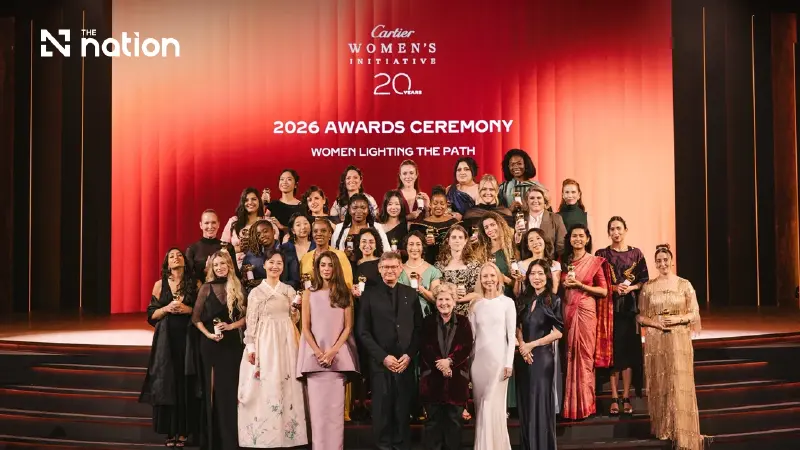


From AI-powered eye clinics to reef restoration and electric last-mile delivery, 30 extraordinary women are changing the world through business — and Thailand's entrepreneurs could be next in line
- The Cartier Women's Initiative celebrated its 20th anniversary by honoring 30 women entrepreneurs from around the world as its 2026 fellows at an awards ceremony in Bangkok.
- The fellows are recognized for creating impactful businesses that address global challenges in sectors like AI-powered healthcare, environmental sustainability, and digital workforce training.
- The initiative provides winners with grant funding of up to $100,000, a year-long fellowship with business coaching, academic training, and access to a global support network.
- The 2026 cohort includes entrepreneurs from diverse countries like Nepal, Colombia, and Uganda, with projects ranging from AI eye-screening clinics to platforms for disabled professionals.
From AI-powered eye clinics to reef restoration and electric last-mile delivery, 30 extraordinary women are changing the world through business — and Thailand's entrepreneurs could be next in line.
They come from Nepal and Colombia, from Morocco and South Korea, from the highlands of Uganda and the tech corridors of San Francisco. Some built their businesses out of personal pain. Others saw a gap the world had long ignored. All of them turned conviction into impact — and last week in Bangkok, Cartier recognised them for it.
On 10 June 2026, the Cartier Women's Initiative celebrated its 20th anniversary by honouring 30 extraordinary women entrepreneurs at its annual awards ceremony, held for the first time in Thailand.
The theme, "Women Lighting the Path", was more than poetic license. These are women who, in markets and communities routinely overlooked, are illuminating what business can do when it puts people and planet first.
What They Built — and Why It Matters
The breadth of the 2026 cohort is staggering. Across ten award categories — nine regional prizes and one Science and Technology Pioneer Award — the fellows are solving some of the world's most stubborn problems with elegant, scalable solutions.
In Latin America, Cristina Campero Peredo's Mexican company PROSPERiA has screened more than 150,000 patients for sight-threatening conditions using an AI platform that works in primary care clinics without specialist staff. More than half of those patients had never received eye care before.

Meanwhile, in Colombia, paediatrician Natalia Cano co-founded Docokids, connecting families with certified paediatric doctors via WhatsApp around the clock — the platform has answered over 450,000 questions, cut unnecessary emergency visits by 91 per cent, and reached families across 39 countries.
In North America, Keely Cat-Wells launched Making Space after experiencing disability discrimination firsthand, building a talent platform that has supported more than 10,000 disabled professionals and boosted each programme participant's projected lifetime earnings by over $1.1 million.
And in Europe, Elise Thorel's Marie Curry in France employs immigrant and refugee women as professional chefs — not invisible kitchen staff — inviting each team member to contribute dishes from their home countries and earn a dignified living from their culinary heritage.
From Africa, the stories are equally vivid. Louisa Gathecha's Bottle Logistics in Kenya has recycled over 66,400 metric tonnes of glass – giving waste pickers formal employment whilst cutting carbon emissions and easing the pressure on one of the world's most over-extracted natural resources.
In Cameroon, Mylène Flicka's Irawo platform is retraining Africa's workforce with practical, employer-partnered digital programmes, already trusted by the Mastercard Foundation and Canal+.
And in Uganda, Susan Namirimu's Mtindo is training unemployed young women as tailors and then employing them — a twin model of education and income that has created 50 jobs a year and raised tailors' earnings by 38 per cent.

The Science and Technology Pioneer Award went to three companies working at the bleeding edge of climate and materials science. Canada's TerraFixing, co-founded by engineer Dr Vida Gabriel, has designed a carbon capture system built specifically for cold climates – requiring just a quarter of the energy of leading alternatives.
In France, Dali Rashid's Genomines is extracting nickel from plants rather than mines, potentially transforming the battery supply chain for electric vehicles.
And Colombia's NanoFreeze, co-founded by Isabel Pulido, has developed biodegradable cooling material that keeps products cold for up to 200 hours without electricity, already saving over $760,000 worth of food from spoilage.
There is also, notably, a first: for the 2026 edition, Cartier recognised a woman impact entrepreneur from Nepal for the very first time.
Prakriti Gautam, co-founder of Khetipati Organics, works with over 1,600 smallholder farmers to transform surplus and seasonal harvests into dried fruits, powders and high-altitude spices — keeping value at the farm gate and employment in the community, most of it filled by women and young people.

Twenty Years in the Making
The Cartier Women's Initiative was launched in 2006, fully funded by Cartier, as a commitment to supporting women-led businesses that use commerce as a force for good.
What began as a recognition programme has evolved, over two decades, into something far more holistic: a year-long fellowship encompassing academic training through INSEAD business school, one-to-one business coaching, executive leadership development, and well-being support.
Financially, first-place awardees receive $100,000 in grant funding, second-place $60,000, and third-place $30,000. But the programme's alumni consistently say it is the community, not the cheque, that transforms them.
Today, the initiative has supported 330 entrepreneurs from 66 countries and distributed over $14.1 million in grants. Its network of 520-plus active community members spans nearly 80 countries.
The numbers behind the fellowship speak for themselves. According to the 2025 Fellow Survey, 76 per cent of recent fellows had increased their revenue since completing the programme, 66 per cent had raised additional financing in 2024, and 44 per cent had entered new markets.
Perhaps more telling: at the end of their fellowship year, 97 per cent reported increased self-confidence, and 100 per cent felt they belonged to a global community.

"Bangkok Is an Epicenter of Creative Energy"
Yanina Novitskaya, CEO of Cartier Southeast Asia and Oceania, described Bangkok as a natural fit for a celebration of women's entrepreneurship.
"In Thailand, the balance between male and female entrepreneurs is almost equal," she said. "The energy and ambition and power is already there. I think it's not only about business skills but also very strong soft skills — communication, humanity, and a very high level of empathy, and a very strong link to culture, to people, and to issues which can be solved in the country."
For Novitskaya, Thailand's ecosystem of powerful women extends far beyond the Cartier office.
"Each time I talk to our dearest clients in Thailand — with whom we have a long history and friendship — they all have additional projects to lead: social impact initiatives, university programmes, and support for artists. Thailand, for me, is an epicentre of creative energy."
She was equally candid about what the anniversary means in the context of the broader initiative.
"This is not just a programme with financial reward," she told journalists. "It is a platform where women impact entrepreneurs can access mentorship, networks, a global community and the support needed to grow their businesses and their impact."

A Message to Thailand's Women Entrepreneurs
Despite the richness of Thailand's entrepreneurial landscape, the country has produced only one Cartier Women's Initiative fellow to date. Novitskaya hopes that hosting the ceremony in Bangkok will inspire more women from Thailand to step forward and apply.
"I promise you, the people I meet here in Bangkok – I travel here every month – there is an enormous variety of great projects."
The message to Thai women entrepreneurs is straightforward: your project is good enough. Novitskaya has seen how Southeast Asian applicants can feel at a disadvantage compared to counterparts from regions with longer-established entrepreneurship ecosystems.
"For Southeast Asian applicants, it can sometimes feel more challenging to compete with entrepreneurs from other regions, where entrepreneurial ecosystems may be more established and confidence levels higher," she acknowledged. "That's why we also want to develop more awareness of the programme here. Hosting the ceremony in Bangkok gives us the opportunity to raise awareness of the programme and inspire women who feel their project is not yet ready to apply."
The programme is open to women-run and women-owned businesses from any country. Shortlisted finalists make ten-minute presentations to a jury of entrepreneurs, investors, former fellows and industry leaders, followed by a twenty-minute Q&A.
The top three from each of the ten award categories are named fellows and receive financial grants, media visibility, networking opportunities, a one-year fellowship programme with INSEAD, and lifelong access to the global community.
A parental stipend is also available for fellows with children under six years old throughout the duration of the fellowship — a detail that reflects the initiative's understanding that women entrepreneurs do not leave their lives at the door.
As Novitskaya put it, summing up two decades of quiet, consistent impact: "We celebrate consistency and a strong belief in the power of collective effort – of women's creativity and entrepreneurial skills. We celebrate the great community which has been created during these two decades. It's not just a women’s impact entrepreneurship programme. It's really a great platform of like-minded people — great women who support each other and inspire each other to go further."
For Thai entrepreneurs ready to take that step, the path is lit. The only question is whether they will walk it.
