
Anutin’s Russia trip tests Thailand’s bid to revive sanctions-hit trade


Prime Minister Anutin Charnvirakul’s visit to Kazan for the ASEAN-Russia summit puts Thailand’s Russia trade strategy under scrutiny, as Bangkok seeks new opportunities in energy, fertiliser and Eurasian markets despite sanctions, payment hurdles and falling bilateral trade.
Anutin’s Russia trip tests Thailand’s bid to revive sanctions-hit trade
Prime Minister Anutin Charnvirakul’s trip to Russia for the ASEAN-Russia summit in Kazan is shaping up as a key test of Thailand’s ability to revive trade with Moscow, as bilateral commerce remains well below pre-war levels and businesses continue to face sanctions, payment and compliance risks.
Anutin, who also serves as interior minister, is scheduled to attend the summit from June 17-18, 2026, with trade, investment and energy cooperation expected to be high on Thailand’s agenda. Government spokesperson Rachada Dhnadirek earlier said the visit was intended to open new markets, create opportunities for Thai businesses, attract investment and strengthen Thailand’s long-term competitiveness.
The summit, held in Kazan, marks 35 years of ASEAN-Russia relations and will include discussions on political, economic and humanitarian cooperation, as well as a Russia-ASEAN Business Forum on June 17.

Trade remains far below pre-war level
The economic challenge facing Anutin is clear. Thai-Russian trade has yet to return to the level recorded before the Russia-Ukraine war, with the value of bilateral trade falling sharply after 2021.
In 2021, before the war, total trade between Thailand and Russia stood at 87.31 billion baht, comprising Thai exports worth 32.65 billion baht and imports worth 54.66 billion baht. Thailand recorded a trade deficit of 22 billion baht.
After the war broke out and sanctions were imposed in 2022, total trade fell to 64.56 billion baht, down 26.06%. Thai exports dropped even more sharply, falling 37.87% to 20.29 billion baht.
Although bilateral trade partly recovered between 2023 and 2025, rising from 52.63 billion baht in 2023 to 57.82 billion baht in 2025, it remained more than 29 billion baht below the pre-war level — a contraction of roughly one-third from the 2021 value.
The latest data for the first four months of 2026 show that the recovery remains fragile. Total trade stood at 17.21 billion baht, down 24.61% from the same period a year earlier. Thai exports plunged 40.07% to 7.85 billion baht, while Thailand returned to a trade deficit of 1.51 billion baht.

Sanctions and payment risks cloud recovery
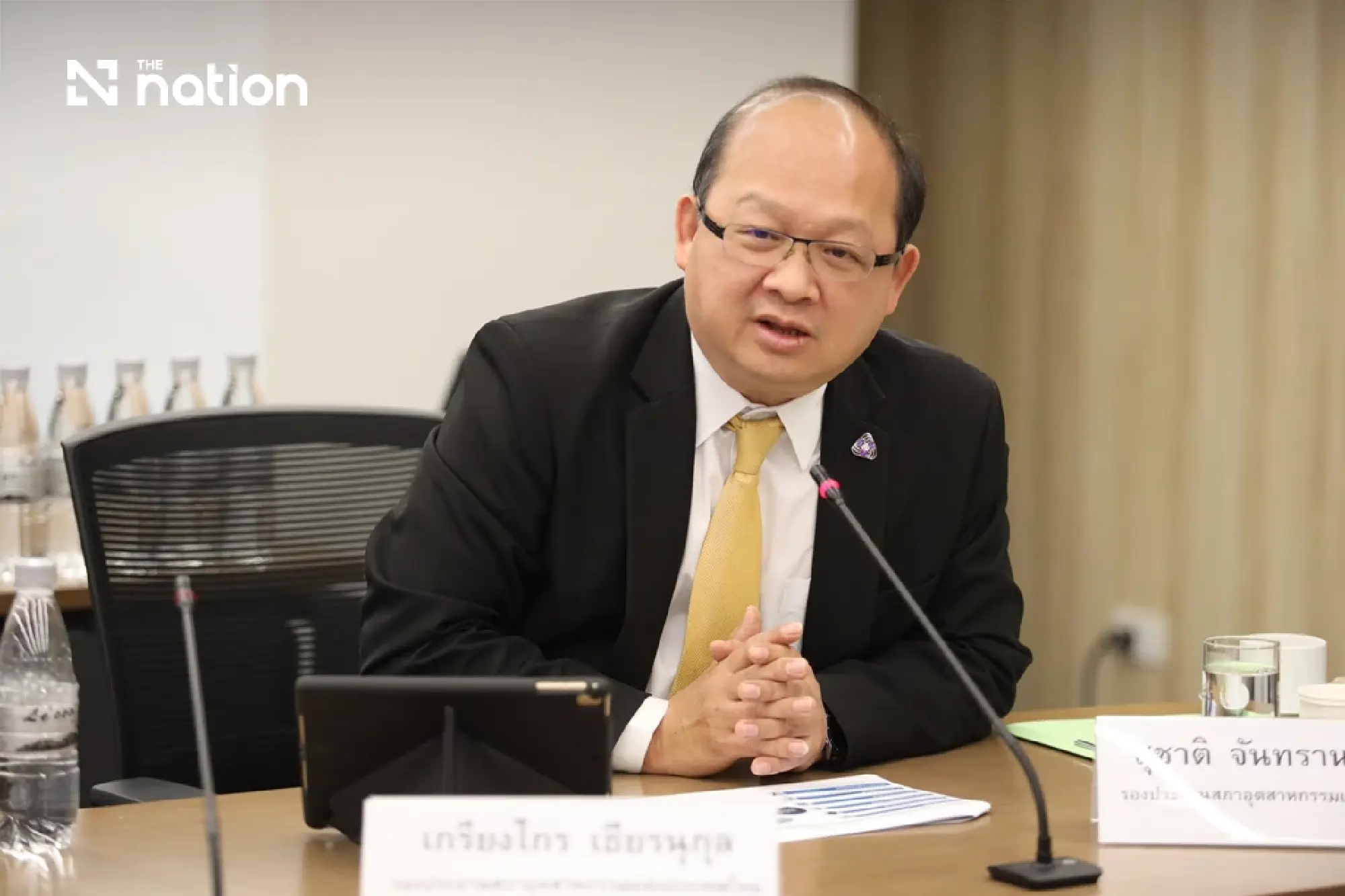
Kriengkrai Thiennukul, honorary chairman of the Federation of Thai Industries and former chairman of the Thai-Russian Business Council, said the biggest factor behind the prolonged slump in Thai-Russian trade was the impact of sanctions imposed by the United States and Europe.
He said payment problems had become the central obstacle, particularly after major Russian banks were cut off from the SWIFT financial messaging system, making settlement for goods far more difficult. The EU Council’s sanctions timeline shows that seven Russian banks were banned from SWIFT in early 2022, while Reuters reported this month that Western sanctions continue to heavily target Russia’s banking system.
Kriengkrai said shipping and travel restrictions had also affected trade, but financial risk was the most serious issue because many businesses feared being blacklisted if they traded with Russia.
Before the war, most Thai-Russian trade was conducted directly. Since payment restrictions took hold, however, businesses have increasingly had to rely on traders or third countries to handle transactions, raising both costs and complexity.
The sanctions environment could become even more difficult. Reuters reported on June 9 that the European Union had proposed a 21st sanctions package targeting nearly 90 Russian banks, crypto platforms, drone production, oil traders and refiners.
Thailand eyes energy and fertiliser opportunities
Despite the risks, Kriengkrai said Thailand still had room to pursue practical economic cooperation with Russia, especially in energy and fertiliser.
He said energy should be a priority if Anutin has an opportunity to meet Russian President Vladimir Putin or Russian business leaders. After Europe reduced purchases of Russian oil, Russia had turned to other markets and offered oil at prices around 20-30% below market levels, he said, adding that this could create an opportunity for Thailand if sanction-related risks could be managed.
Fertiliser is another potential area of cooperation. Thailand has expressed interest in importing 1-2 million tonnes of granular urea fertiliser annually from Russia, while both sides have discussed setting up a joint working group to address trade issues and streamline import-export procedures.
Kriengkrai said such imports could significantly reduce costs for Thai farmers, although delivery had not been completed in time for this year’s production cycle.
Russia as a gateway to Eurasian markets
The former Thai-Russian Business Council chief said Thailand and Russia had once targeted bilateral trade of US$10 billion, a goal set in 2014 during the government of General Prayut Chan-o-cha and intended to be reached by 2016.
However, even at its strongest point, bilateral trade reached only slightly above US$4 billion, falling short of the target. Since the geopolitical shock caused by the Ukraine war, trade has continued to weaken.
Thailand has also run a persistent trade deficit with Russia because it imports high-value capital goods and raw materials, including oil, fertiliser, chemicals, steel, minerals and coal. Thailand’s main exports to Russia include auto parts, plastics, processed food and clothing.
Kriengkrai said that if geopolitical tensions ease, Thai-Russian trade still has strong growth potential — not only in Russia itself, but also in the Eurasian Economic Union, or EAEU, whose members are economic partners of Russia and together represent a market of almost 200 million people.
“If Thailand can penetrate the Russian market, it will become an important gateway for distributing Thai products to partner countries in the same region,” he said.
For Anutin, the Kazan summit is therefore more than a diplomatic appearance. It is a test of whether Thailand can convert Russia’s demand for new trade partners into real economic gains, while avoiding the financial and compliance risks that have held businesses back since the war began.
